Core Beliefs: 50 Examples and a Free Worksheet
Below are 50 core beliefs examples, grouped into beliefs about yourself, other people, the world and the future, each paired with a balanced alternative. The term comes from cognitive behavioral therapy (CBT): Judith Beck of the Beck Institute describes core beliefs as “a person’s most fundamental understanding of themselves, their worlds and other people, and their futures” (Beck Institute).
Use the tables to put words to a belief you recognize. Then use the free worksheet to find your own and start testing it.
What core beliefs are (vs thoughts and limiting beliefs)
Core beliefs sit underneath your everyday thinking. They tend to be short, absolute statements. A summary of Judith Beck’s approach puts it this way: “These beliefs are often expressed as broad, absolute statements, such as, ‘I am worthless,’ ‘I am helpless,’ or ‘I am unlovable’” (Psychiatry & Psychotherapy Podcast). The same article notes that, unlike automatic thoughts, “core beliefs are relatively stable over time and are viewed by the individual as fundamental truths.”
They often start early. Beck writes that “the process often begins in childhood, as young people seek to make sense of their negative experiences” (Beck Institute).
Here is how the layers fit together:
| Layer | What it is | Example |
|---|---|---|
| Automatic thought | A quick reaction to one moment | “She hasn’t replied. She’s annoyed with me.” |
| Intermediate belief | The meaning you draw from it | “It means I’ve messed up again.” |
| Core belief | The broad conclusion underneath | “I’m unlovable.” |
A limiting belief is a looser, everyday term for any belief that holds you back, such as “I’m too old to learn piano.” Many limiting beliefs look like a core belief showing up in one area of life, so it’s worth asking what broader belief sits behind yours.
One reason core beliefs feel so true: they filter what you notice. Beck explains that people “often become hypervigilant for signs that their core belief is true” and tend to “discount positive evidence” (Beck Institute).
The examples below are illustrations, not a diagnosis. The balanced alternatives aren’t forced positivity. Healthy beliefs, in Beck’s words, are “fairly realistic, flexible beliefs about themselves that are not overly positive or overly negative.”
Core beliefs examples about yourself
These are the most common and the most painful. Many fit one of three families: helpless (I can’t cope), unlovable (I’ll be rejected) or worthless (I’m bad or I don’t matter).
| Core belief | A balanced alternative |
|---|---|
| I’m unlovable. | Some people have loved me, and more can. Being lovable doesn’t require being perfect. |
| I’m a failure. | I’ve failed at some things and done well at others. Failing is an event, not who I am. |
| I’m not good enough. | I’m good enough to keep learning. “Enough” is a standard I get to question. |
| I’m worthless. | My worth isn’t a score I have to earn. I matter on bad days too. |
| I’m stupid. | Some things are hard for me and some come easily. I can learn what I don’t know yet. |
| I’m helpless. | I can’t control everything, but I can usually take one useful step. |
| I’m weak. | I’ve gotten through hard things before. Struggling isn’t the same as being weak. |
| I’m a burden. | People who care about me choose to help, and I give back in my own ways. |
| I’m boring. | I’m quieter with some people than others. The right people find me interesting. |
| I’m broken. | I’ve been hurt, and I’m still capable of growth and connection. |
| I’m bad. | I’ve done things I regret. I can make amends and act on my values. |
| I’m a fraud. | I earned at least some of what I have. Still learning is normal, not fake. |
| I’m unattractive. | Attraction varies a lot from person to person. My looks are one part of me. |
| I don’t deserve good things. | Good things aren’t handed out by merit. I can accept them when they come. |
| I’m different and I don’t fit in. | I’m different in some ways. There are people and places where I fit. |
Examples about other people
Beliefs about others shape how close you let people get and how you read their behavior.
| Core belief | A balanced alternative |
|---|---|
| People can’t be trusted. | Some people can’t be trusted and many can. Trust can be built a step at a time. |
| People always leave me. | Some relationships end. Others last, and I can invest in those. |
| Everyone is better than me. | People are better at some things and worse at others. Ranking whole people doesn’t work. |
| People only care about themselves. | Everyone looks after their own interests, and many people care about others too. |
| If people really knew me, they’d reject me. | People who know me well are still around. Being known is how closeness grows. |
| If I let people close, they’ll hurt me. | Closeness carries some risk. I can choose who to trust and set limits. |
| People are always judging me. | Most people are busy with their own lives. A few opinions don’t define me. |
| Nobody understands me. | Some people understand parts of me, and I can help them understand more. |
| People are dangerous. | A few people are dangerous. Most aren’t, and I can learn to tell the difference. |
| Other people’s needs matter more than mine. | Needs aren’t a ranking. Mine count alongside everyone else’s. |
| People only like me for what I do for them. | Some people like me for who I am. I can notice who stays when I ask for nothing. |
| People in charge will always put me down. | Some people in charge have been unfair. Others have been fair, and I can speak up. |
Examples about the world
These beliefs set your sense of safety and fairness. They often come from a hard period that taught a lesson too well.
| Core belief | A balanced alternative |
|---|---|
| The world is a dangerous place. | Some places and situations are risky. Most of daily life is reasonably safe. |
| Life is unfair. | Some things are unfair and some go my way. I can act on what I can change. |
| Nothing ever works out for me. | Some things haven’t worked out. Others have, including small ones. |
| You have to fight for everything. | Some things take effort. Others come through help, timing or luck. |
| The world is cold and uncaring. | There’s indifference out there, and also a lot of kindness, often from strangers. |
| Mistakes are unforgivable. | Most mistakes can be fixed, forgiven or learned from. |
| It’s every person for themselves. | Competition is real, and so is cooperation. Most things get done together. |
| Good things never last. | Everything changes, good and bad. I can enjoy what’s good while it’s here. |
| Success is for other people. | Success comes in many sizes, and some of it is within my reach. |
| Everything is falling apart. | Some things are going badly, some are improving, and a lot hasn’t changed. |
| If I relax, something bad will happen. | Staying on alert doesn’t prevent most bad things. Rest helps me cope when they do. |
| Change always makes things worse. | Some changes have hurt. Others brought things I’m glad to have. |
Examples about the future
Beliefs about the future decide whether trying feels worth it. They often sound like predictions, so test them like predictions.
| Core belief | A balanced alternative |
|---|---|
| Things will never get better. | I can’t see the future. Things have changed before and can again. |
| I’ll always be alone. | I feel alone right now. Connection is something I can work toward. |
| I’ll never succeed. | I haven’t succeeded at this yet. Slow progress is still progress. |
| Something bad is bound to happen. | Bad things happen sometimes. Worrying early doesn’t stop them, and I can cope. |
| It’s too late for me. | It’s later than I’d like, and there’s still time to start. |
| I’ll never change. | I’ve changed before, even in small ways. Change is gradual. |
| If I try, I’ll fail. | If I try, I might fail or succeed. If I don’t try, I learn nothing. |
| My past decides my future. | My past shapes me. My choices from here count too. |
| I’ll end up just like my parents. | I share some traits with my family. I can choose which ones to keep. |
| I’ll never be happy. | Happiness comes and goes for everyone. I can notice and build the good moments. |
| I won’t be able to cope. | I’ve coped with hard things before, sometimes with help. I can again. |
How to find your core beliefs (the downward arrow)
Reading a list helps, but your own belief is usually worded a little differently. The downward arrow technique, described by psychiatrist David Burns, follows one upsetting thought down to the belief underneath it. Burns is clear that “the purpose of the Downward Arrow Techniques is uncovering the patient’s SDBs, not change” (SDBs are his term for self-defeating beliefs) (Feeling Good). So the aim here is finding, not fixing.
- Pick one thought. Burns advises always starting with a specific negative thought. Choose a recent moment that stung and write the exact thought you had.
- Assume it’s true. Don’t argue with it yet. Burns’s question is: “Why would it be upsetting to you if this thought were true? What would it mean to you?”
- Draw an arrow and write the answer. Then ask again about that answer. Other useful prompts, from the Manhattan Center for CBT, include “What does that say about you?” and “And why does that bother you?”
- Repeat until it stops moving. You’ve usually arrived when the answer is short, absolute and about you, other people, the world or the future, and it feels heavy rather than clever.
- Compare it with the tables above. Use your own words if they fit better.
A worked example:
| Step | What you write |
|---|---|
| Thought | “My manager didn’t comment on my report.” |
| If that were true, what would it mean? | “She thinks it was bad.” |
| And what would that mean? | “I’ll never be as good as the others on my team.” |
| What does that say about you? | “I’m not good enough.” |
“I’m not good enough” is the core belief. The first thought was only the doorway.
Go gently. Reaching a core belief can stir up strong feelings. If it gets too much, stop and come back another day.
Free core beliefs worksheet
The worksheet walks you through the downward arrow, a belief check (evidence for and against), and a rewrite that turns your balanced belief into a short self-hypnosis suggestion. It’s three printable pages.
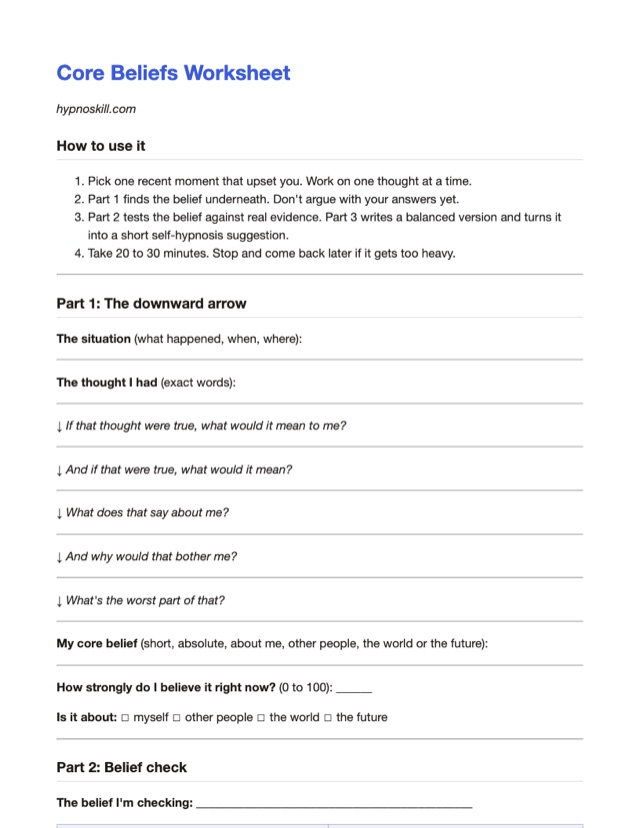
Changing a core belief: gather evidence, then rehearse the new one
Core beliefs change slowly, through repetition rather than a single insight. Two habits do most of the work.
1. Collect evidence on purpose
Because a core belief filters what you notice, you have to look deliberately for what it leaves out. Beck describes CBT helping people “recognize their positive qualities” and “integrate positive experiences to contradict their negative beliefs” (Beck Institute).
- Write your old belief and your balanced alternative at the top of a page.
- Each evening, note one or two things that day that fit the balanced belief. Small counts: someone thanked you, you finished a task, you handled a tense moment.
- Rate how much you believe each version from 0 to 100, once a week. You’re looking for a shift, not a flip.
Expect the old belief to return under stress. The Beck Institute notes that core beliefs “never go away; however, they can become latent with CBT treatment, diminishing their adverse effects,” and that a reactivated belief can be quieted again (Beck Institute). A flare-up is a cue to practice, not proof that nothing changed.
2. Rehearse the balanced belief with self-hypnosis
Evidence makes the new belief believable. Rehearsal makes it familiar. This is where you can rehearse it with self-hypnosis: a few minutes of focused, relaxed attention in which you repeat the new belief as a suggestion.
To turn a balanced belief into a suggestion:
| Old belief | Balanced belief | Self-hypnosis suggestion |
|---|---|---|
| I’m not good enough. | I’m good enough to keep learning. | “Each day I notice what I do well, and I keep learning.” |
| People always leave me. | Some relationships last, and I can invest in those. | “I invest in the people who show up for me.” |
| I’ll never cope. | I’ve coped before, sometimes with help. | “I’ve handled hard things before. I can take the next step.” |
Keep suggestions short, in the present tense, in your own voice, and believable. If a line makes you wince, soften it until it feels like a stretch rather than a lie.
When to get support
This page is a self-help exercise, not therapy. If the beliefs you uncover are tied to depression, trauma or thoughts of harming yourself, a therapist trained in CBT can help you work through them safely. If you’re thinking about harming yourself, call or text 988 (the US Suicide & Crisis Lifeline) or your local emergency number now.
Frequently asked questions
- What are the 3 core beliefs?
- The three usually meant are helpless, unlovable and worthless. A summary of Judith Beck's CBT gives "I am worthless," "I am helpless" and "I am unlovable" as typical examples of how negative core beliefs about the self are expressed.
- Can core beliefs change?
- Yes, they can loosen and lose their grip. The Beck Institute notes that negative core beliefs may not vanish completely, but they can become latent, and when they flare up again they can be quieted using the same skills.
- What is the difference between core beliefs and values?
- A core belief is a conclusion about what is true, such as "I'm not good enough." A value is a choice about what matters to you, such as honesty or kindness, and it guides how you act whatever you believe about yourself on a given day.