Self-Hypnosis: How to Do It, Step by Step
Self-hypnosis is a way of guiding your own attention into a narrow, absorbed focus, then using that focus to rehearse a calm feeling, a habit or a goal. You don’t need a hypnotist, a swinging watch or any special talent: self-hypnosis is a skill you can learn and train, a little like learning to meditate or to stretch properly.
By the end of this page you’ll be able to run a complete 10-minute session on your own, pick the technique that suits you, write your own suggestions, and follow a 7-day plan to make it stick. You’ll also get an honest summary of what the research supports and where it falls short.
What self-hypnosis is (and isn’t)
The American Psychological Association’s hypnosis division defines hypnosis as “a state of consciousness involving focused attention and reduced peripheral awareness characterized by an enhanced capacity for response to suggestion” (Elkins et al., 2015, quoted by Psychology Tools). In plain terms: you narrow your attention, the rest of the world fades into the background, and you become more responsive to ideas you choose to focus on.
Self-hypnosis is the same state, guided by you. A Stanford training manual for clinicians goes further and says that “all hypnosis is self-hypnosis”: a hypnotist only helps you get into a state your own mind produces (Stanford Center on Stress and Health).
What it isn’t:
- It isn’t sleep. In a 2016 Stanford brain-imaging study, highly hypnotizable people showed specific changes during hypnosis, including reduced activity in the dorsal anterior cingulate, a brain area involved in deciding what deserves your attention (Stanford Medicine; Cerebral Cortex). As the study’s senior author, psychiatrist David Spiegel, put it: “In hypnosis, you’re so absorbed that you’re not worrying about anything else.”
- It isn’t mind control. Cleveland Clinic is clear that hypnosis “isn’t mind control or brainwashing” and that you stay in control of your mind and thoughts (Cleveland Clinic). You can’t be made to do something you don’t want to do, and you can stop at any moment.
- It isn’t magic. It works on attention, relaxation and how you rehearse things in your mind. There are things it can’t do, and we cover them in what hypnosis can’t do.
Spiegel describes self-hypnosis as “a way to direct highly focused attention,” using tools borrowed from meditation, like physical sensations and visualization (Stanford Medicine). You’re training your attention, on purpose.
Your first self-hypnosis session in 10 minutes
Every session has four stages:
- Induction: shift from everyday attention into a narrow focus.
- Deepener: settle further into that focus.
- Suggestion: rehearse the idea or feeling you want.
- Exit: count yourself back to normal alertness.
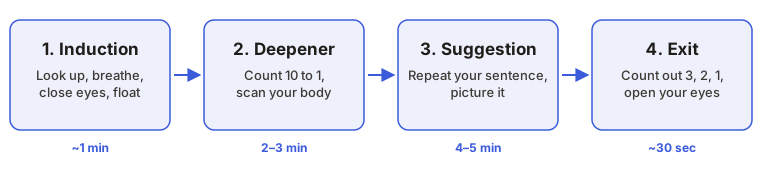
The steps below use the eye-roll induction taught by Spiegel’s group at Stanford, because it’s quick and easy to remember (Stanford Center on Stress and Health).
Before you start (1 minute)
- Pick one goal for this session. Keep it simple: feeling calmer, settling before sleep, or focusing on one task.
- Write one sentence for it. For example: “My body feels heavy and calm, and my breathing is slow.” (More on writing suggestions below.)
- Sit somewhere comfortable with your feet on the floor and your hands resting on your thighs. A chair works better than a bed for a first session, because you’re less likely to fall asleep.
- Silence your phone and set a gentle timer for 12 minutes, so you don’t have to watch the clock.
The session (about 10 minutes)
- Look up (induction, 1 minute). Without moving your head, look up toward your eyebrows, as high as you comfortably can. Take a deep breath and hold it for a moment.
- Close and float. Slowly close your eyes while keeping your gaze turned up. Breathe out, let your eyes relax behind your closed lids, and let your body feel like it’s floating, as if you were lying in warm water.
- Count down (deepener, 2 to 3 minutes). Count slowly from 10 down to 1, one number on each out-breath. With each number, imagine sinking a little further into the chair. If your mind wanders, notice it and return to the next number. That return is the skill you’re training.
- Scan your body. Starting at your forehead, move your attention slowly down through your jaw, shoulders, arms, belly and legs. At each spot, let the floating feeling spread a little more.
- Repeat your suggestion (4 to 5 minutes). Say your sentence slowly in your head. Then picture it: see yourself calm, asleep, or working with focus, in as much detail as you can. Repeat the sentence a few more times, unhurried, letting it feel true for now.
- Count out (exit, 30 seconds). Count backward from 3. On 3, get ready. On 2, with your eyelids still closed, roll your eyes up again. On 1, let your eyes open slowly and notice that you feel awake and alert.
- Take a note. Jot down one line: how absorbed you felt (low, medium, high) and what pulled your attention away. These notes are how you’ll see progress over the week.
A short script to read or record
You can read this slowly to yourself, or record it on your phone and play it back. Leave a pause of a few seconds at each “…”.
Get comfortable… Look up toward the top of your head, as high as you can… Take a deep breath, and hold it… Now close your eyes, keep looking up behind your eyelids, and breathe out… Let your eyes relax… Let your body float, as if you were resting in warm water…
I’m going to count down from ten to one. With each number, you float a little deeper… Ten… nine… eight… feeling heavier and lighter at the same time… seven… six… five… four… three… two… one…
Now let your attention move slowly down your body… your forehead softens… your jaw unclenches… your shoulders drop… your arms and hands rest… your legs grow heavy…
In this calm, focused state, you hear your sentence: [your suggestion]… Picture it happening… See the details… Notice how it feels… [your suggestion]…
In a moment, you’ll count back from three… Three, getting ready… Two, with your eyes closed, roll them up… One, let your eyes open slowly, awake and alert.
If you record it, speak more slowly than feels natural. A rushed recording can make a first session feel flat.
Three self-hypnosis techniques compared
The four stages stay the same. What changes is mostly the induction, the way you get into focus. These are three well-documented starting points:
- Eye fixation goes back to James Braid, the Scottish physician who, in the mid-19th century, became the first major figure to tie hypnosis to eye fixation and “favored an induction involving a strained upwards fixation of the eye” (Cardeña et al., PLOS ONE, 2017). You fix your gaze on one point, slightly above eye level, until your eyelids feel heavy and you let them close.
- Progressive muscle relaxation was “originally proposed by Jacobson in 1929,” and works by tensing and releasing muscle groups throughout the body (Frontiers in Public Health, 2026). It isn’t hypnosis on its own, but it makes a solid induction if you hold a lot of tension.
- The eye-roll and float comes from psychiatrists Herbert and David Spiegel, who used the ability to roll the eyes upward as an indicator of hypnotic capacity (PLOS ONE, 2017). Their group pairs the eye roll with a floating image to start a session (Stanford Center on Stress and Health).
| Technique | Origin | Time to get into focus | Difficulty | Best for |
|---|---|---|---|---|
| Eye fixation | James Braid, 19th century | A few minutes | Easy | Beginners who like a clear physical cue; sessions at a desk |
| Progressive muscle relaxation | Edmund Jacobson, 1929 | Longer (you work through the whole body) | Easy | Evenings, bedtime, days when your body feels tense |
| Eye-roll and float | Herbert and David Spiegel | Under a minute once practiced | Easy to learn, takes practice to feel quick | Short sessions during the day; a 1-minute reset before stressful moments |
Start with the eye-roll in the session above. If it feels abrupt, use progressive muscle relaxation as your induction for the first week, then switch.
A note on the eye roll: whether your eyes show a lot of white when you look up isn’t a reliable test of whether hypnosis will work for you. Researchers report that the eye-roll sign “has only weak positive correlations” with measured hypnotizability (PLOS ONE, 2017). Use it as an induction, not as a verdict.
Writing your own suggestions
The suggestion is the part of the session where you tell your focused mind what to rehearse. Three rules make suggestions work better:
- Present tense. “I am calm” rather than “I will be calm.” You’re rehearsing the feeling now, not promising it for later.
- Positive. Say what you want, not what you’re avoiding. “My breathing is slow” works better than “I’m not anxious,” because the second one keeps the word anxious in the spotlight.
- Specific. Name a situation, a body sensation or an action you can picture. Vague goals give your imagination nothing to work with.
Five examples you can adapt:
| Goal | Suggestion |
|---|---|
| Sleep | “My body is heavy and warm, my thoughts slow down, and I let the bed hold me.” |
| Focus | “When I open my laptop, I start with the first task and my attention stays on it.” |
| Confidence | “I walk into the meeting, stand tall, and speak at an easy, steady pace.” |
| Calm | “When I feel tension rise, I breathe out slowly and my shoulders drop.” |
| Habits | “When I finish dinner, I get up, put the plate away and make a cup of tea.” |
Notice that the habit suggestion describes the new action step by step instead of fighting the old one. If a goal keeps stalling, the obstacle is often an underlying belief (“I’m just not a focused person”). Our guide to finding the belief to work on will help you spot it and write a suggestion that addresses it directly.
Keep one suggestion per session. Use the same wording for a week before you change it, so you’re training one idea instead of scattering your attention.
Does self-hypnosis work?
The short answer: there is real evidence for some uses, mixed evidence for others, and big differences between people. Here’s what the research says.
What the evidence supports:
- Self-hypnosis as a trained skill. A meta-analysis of 22 randomized controlled trials found “a medium-to-large effect size for self-hypnosis in clinical treatment,” with benefits in studies of pain, childbirth, paediatric uses, stress and anxiety (Eason & Parris, Psychology of Consciousness, 2019). The same review found self-hypnosis worked best when it was “taught as an independent self-directed skill” and involved “at least three practice sessions” before the trial.
- Sleep, with caveats. A systematic review of 24 studies found that 58.3% reported a benefit of hypnosis on sleep outcomes, 12.5% mixed results and 29.2% no benefit. The authors called it “a promising treatment that merits further investigation” and noted that many studies were small or of low quality (Chamine et al., Journal of Clinical Sleep Medicine, 2018). So self-hypnosis may help you relax at bedtime, but it isn’t a proven fix for sleep problems.
- Relaxation itself. Progressive muscle relaxation, one of the inductions above, has been studied on its own: a 2026 meta-analysis of 14 randomized trials concluded that it “improves subjective sleep quality in adults” (Frontiers in Public Health, 2026).
Where it falls short:
- Just listening isn’t enough. In the same meta-analysis on self-hypnosis, trials that found no effect “typically involved participants listening to audio recordings of hetero-hypnosis only” (Eason & Parris, 2019). Recordings help, but the practice is what you’re building.
- People differ. Stanford researchers note that “only about 10 percent of the population” is generally categorized as highly hypnotizable (Stanford Medicine). Spiegel has said that about two thirds of adults are hypnotizable to some degree (Huberman Lab). If you’re in the less responsive group, you can still get the relaxation and the mental rehearsal, but the effects may be smaller.
- Weight and other big changes. Claims about hypnosis for weight loss and similar goals are often oversold. We look at the actual studies in does hypnosis work for weight loss, and at the hard limits in what hypnosis can’t do.
Self-hypnosis is a practice for attention and relaxation. It doesn’t replace medical or psychological care.
Is self-hypnosis safe?
For most people, yes: you stay aware and in control throughout, and Cleveland Clinic describes side effects of hypnosis as rare, mostly things like dizziness, headaches or a short spike in anxiety (Cleveland Clinic). A review of sleep studies likewise found a “low incidence of adverse events” (Chamine et al., 2018). If you have a serious mental health condition, talk to your doctor before you start, and read is self-hypnosis safe for the full picture.
Troubleshooting
“I can’t relax.” Stop telling yourself to relax. Stanford’s clinical guidance points out that a direct instruction to “relax” can actually raise anxiety, and recommends an image like “floating” or “lightness” instead (Stanford Center on Stress and Health). Picture warm water holding you up. If your body still feels wired, switch to progressive muscle relaxation for a few days: tensing first makes releasing easier to feel.
“I fell asleep.” That’s common, and it tells you your body was ready for rest. If your goal is better sleep, it’s a fine outcome. If your goal is focus or confidence, sit upright in a chair, practice earlier in the day, and keep your hands resting on your thighs rather than folded.
“Nothing happened.” Hypnosis usually feels more ordinary than people expect. There’s no blackout and no dramatic switch, just a calm, narrowed focus where time may pass quickly. Rate your absorption honestly after each session and compare day 1 with day 7. The research above found that practice before testing mattered, so judge it after a week, not after one try.
“My mind keeps wandering.” It will. Each time you notice and come back to the count or your sentence, you’ve done one repetition of the skill. Shorten the session if needed: a focused 5 minutes beats a distracted 15.
A 7-day self-hypnosis practice plan
Use the same suggestion all week. Practice at about the same time each day and take your one-line note after every session.
| Day | Practice | Time | Focus |
|---|---|---|---|
| 1 | Full session with the script, eye-roll induction | 10 minutes | Learn the four stages; don’t judge the result |
| 2 | Full session, read or play your recorded script | 10 minutes | Slow the countdown; notice where your mind wanders |
| 3 | Full session with progressive muscle relaxation as the induction | 12 minutes | Compare the two inductions; keep the one that feels easier |
| 4 | Full session from memory, no script | 10 minutes | Run all four stages on your own |
| 5 | Full session, plus a 1-minute version later in the day (look up, breathe, float, one suggestion, count out) | 10 + 1 minutes | Practice getting into focus quickly |
| 6 | Full session with a longer suggestion stage | 12 minutes | Add more detail to the scene you picture |
| 7 | Full session, then review your notes for the week | 10 minutes | Decide what to keep, and whether to change your suggestion for next week |
After day 7, keep one daily session as your base and use the 1-minute version before the moments that matter: a presentation, a hard conversation, or the moment you turn off the light.
Want the session in your hand? The printable script has the steps, the full script and space for your suggestion.
Frequently asked questions
- Is self-hypnosis real?
- Yes. Brain-imaging research at Stanford found measurable changes in brain activity during hypnosis, and a review of randomized trials found that self-hypnosis had a real effect in areas like pain, stress and anxiety. It is a state of focused attention, not sleep and not mind control.
- How long does self-hypnosis take to work?
- The calm, absorbed feeling can show up in your first session, but don't judge the skill on one try. In the research, self-hypnosis tended to work best when people had practiced several times before it was tested, so give it at least a week of short daily sessions.
- Can you get stuck in self-hypnosis?
- No. You stay aware and in control the whole time, so you can open your eyes whenever you choose. The worst that usually happens is that you drift off to sleep and wake up normally.
- How often should you practice self-hypnosis?
- Short and frequent beats long and rare. One 10-minute session a day is a good starting point, and once the steps feel familiar you can add a 1-minute version before stressful moments.